


Property Reinsurance/ ILS Insurance Linked Strategies is a hedge fund strategy that many of the largest pension, sovereign wealth, and endowment funds have exposure to and there are 4 reasons other institutional investors should consider the strategy.
1. Forward modeled returns remain competitive with most fixed-income-oriented alternatives
When evaluating reinsurance as a strategy, forward-looking modeled returns are more important than historical returns. Reinsurance returns are heavily influenced by current market pricing relative to expected catastrophe losses and the amount of capital required to assume those risks.
The probability of hurricanes, earthquakes, and other natural catastrophes is relatively stable over long periods. What changes materially is the price investors receive for assuming that risk.
The history of the market illustrates this clearly. Following Hurricane Katrina in 2005, reinsurance pricing increased significantly as insurers and reinsurers sought to rebuild capital and capacity. The attractive pricing subsequently attracted substantial institutional capital into the market. Over time, that influx of capital increased capacity and pushed risk-adjusted pricing lower. Beginning around 2016, lower pricing coincided with a period of above-average catastrophe losses, resulting in weak reinsurance returns through approximately 2022. Those mediocre returns caused capital to leave the industry, reducing available capacity and eventually pushing risk pricing higher. That dynamic helped produce the strong reinsurance returns of recent years.
The market has softened somewhat from its most attractive levels, but current forward modeled returns in the high single digits to low double digits remain reasonable estimates for appropriately structured property catastrophe reinsurance portfolios. These expected returns compare favorably with many fixed-income-oriented strategies when you consider that the yield of the 10-year treasury is below 5% and BBB rated bonds only yield about 100 basis points more.
2. “True” Low Correlation
Correlations of asset classes and investment strategies are not constants; they are conditional. A strategy showing 0.2 correlation to equities across a full cycle can show 0.8 in the quarter during a market selloff. This is not a statistical quirk, it is structural as most strategies marketed as diversifying are short the same underlying factor: liquidity. Merger arbitrage, convertible arbitrage, credit relative value, structured credit, and emerging market debt each earn part of their return by supplying liquidity or bearing funding risk. When funding tightens across the system, those positions are unwound simultaneously, and the diversification an allocator believed they owned disappears precisely when it was needed.
Private credit deserves specific mention. More than a trillion dollars has moved into the asset class even as spreads have compressed and average loan quality has drifted lower. Much of its appeal rests on high reported Sharpe ratios, steady quarterly marks, and shallow drawdowns, but appraisal-based and mark-to-model valuations are inherently smoothed. The market has not been tested in a 2008 type market meltdown and could potentially experience significant credit defaults across the industry.
Property catastrophe reinsurance differs in kind, not degree. Its return depends on whether a hurricane makes landfall in Florida, whether a fault ruptures in Japan, whether a wildfire runs through a wildland-urban interface in California. None of those outcomes are conditioned on discount rates, credit spreads, earnings revisions, or investor risk appetite. That is a far more durable foundation than a low observed correlation coefficient, which is an empirical artifact that can and does break.
3. Liquidity
The global financial crisis demonstrated that liquidity in fixed-income markets can disappear precisely when investors need it most. During periods of severe stress, fixed-income strategies can experience large drawdowns alongside significant redemption requests, forcing managers to sell into deteriorating markets, impose gates, or suspend redemptions. A comparable episode today would land on a private credit market that has never been tested at its current size, and would likely coincide with a surge in defaults.
Reinsurance offers something structurally unusual: liquidity that does not require a buyer or a payoff.
Traditional property catastrophe reinsurance contracts are generally written for terms of twelve months or less. Reinsurance funds, unlike reinsurance companies that can use leverage, must place assets into a collateral account or trust for all potential liabilities. If no qualifying loss occurs, the contract expires, the supporting collateral is released, and the position self-liquidates. No secondary market bid is needed, no counterparty must be found, and the investor does not have to accept a distressed price. The portfolio converts back toward cash through the passage of time rather than through the act of selling an asset into a stressed market or hoping to be repaid when a debt matures.
The industry's renewal calendar reinforces this characteristic. Approximately 45–50% of global property catastrophe capacity renews on January 1, representing predominantly Retro, U.S. Nationwide, European, and global programs. The Japanese market has a significant April 1 renewal, while June 1 and July 1 are important renewal dates for Florida and broader U.S. catastrophe business. For an investor with a diversified portfolio, this creates a relatively predictable pattern of contractual run-off, with a substantial portion of the portfolio maturing around year-end and another significant portion around the middle of the year.
This liquidity gives investors the dry powder to take advantage of dislocations within other markets or provides cash to help fund the operation without having to sell securities at depressed prices.
It is important to note that this discussion is relative to the underlying reinsurance contracts. Actual fund vehicles may have different liquidity terms. When doing due diligence on a fund, it is important to know if the fund has a fronting agreement to eliminate most trapped capital and to also understand the fund’s history of side pockets.
4. Tail risk relative to other asset classes and strategies
Reinsurance is commonly caricatured as attractive returns sitting on top of an unquantifiable tail. The caricature has it backwards.
Although the probability of hurricanes, earthquakes, and other natural disasters does not change much each year, actual loss outcomes vary widely year to year, and the distribution is explicitly modeled and explicitly priced. Managers can and do present a full exceedance probability curve at current market pricing: the no-loss return, the median, the 1-in-10, the 1-in-20, the 1-in-100. Investors tend to fixate on the 1-in-100 and stop there. What investors miss is that almost no other asset class or strategy can tell you what its 1-in-100 year looks like before you invest. Equities, credit, and hedge fund strategies all carry tail risk; theirs are simply undisclosed.
When the comparison is made on equal terms, reinsurance looks considerably better than its reputation:
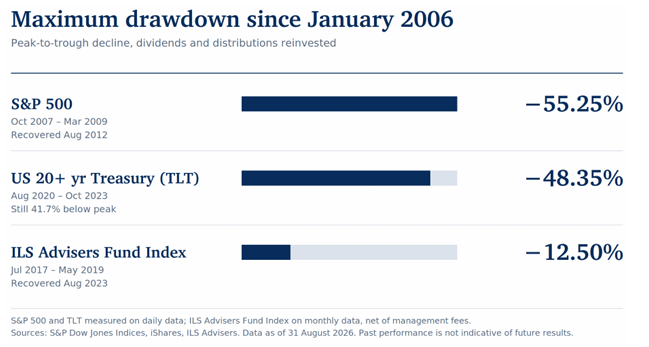
The multi-year picture is stronger still, because the asset class contains its own recovery mechanism. A major loss year withdraws capital from the market, which tightens capacity and raises pricing, so that the years immediately following a large loss are typically the best-priced years available. Equity and credit drawdowns require a market to change its mind. Reinsurance drawdowns are repaired by a supply response that follows from the loss itself. It is important to note that the reinsurance index contains a high percentage of cat bonds, which have lower long term returns and have had lower volatility this century.
Conclusion
Property reinsurance currently offers four potential benefits to an institutional portfolio:
- **Attractive forward-looking returns: **Property reinsurance can offer modeled forward returns that are higher than those available from many traditional fixed-income strategies.
- True diversification: The asset class has historically demonstrated low correlation to many traditional investment strategies and asset classes, providing meaningful portfolio diversification.
- Potential liquidity during market stress: Property reinsurance may provide a source of liquidity during prolonged market selloffs, when other asset classes can become less attractive or more difficult to monetize.
- A potentially more attractive tail-risk profile than perceived: While property reinsurance is often viewed as carrying significant tail risk, carefully constructed portfolios and disciplined underwriting can potentially manage downside volatility more effectively than the headline risk profile might suggest.
That said, not all reinsurance managers are created equal. Managers can differ significantly based on the areas of the market in which they focus, their ability to add value through contract-level underwriting, and most importantly, how effectively they manage and control downside volatility at the portfolio level.
For institutional investors, thorough due diligence is therefore critical. Understanding a manager's underwriting process, portfolio construction, risk controls, catastrophe exposure, historical performance through different market environments, and approach to managing tail risk is essential before making an investment.
