


These are undoubtedly interesting times for interest rates and for all the wrong reasons, indicating that elevated Treasury yield may well threaten the current market rally.
Plenty of experts and members of the smart money crowd are calling attention to the fact that 30-year Treasury yields recently hit the highest level in 19 years. Alone, that’s a threat to the market rally and one made all the more ominous when considering that 30-year yields’ 2007 ascent occurred just prior to the onset of the global financial crisis.
Adding to the potential peril in the bond market is the point that the Federal Reserve is stuck between a rock and a hard place. The U.S. economy, though mostly solid, is cooling. Jobs data confirm as much. That should set the stage for interest rate cuts. However, thanks in part to the war in Iran and too much government spending, inflation remains stubbornly high, implying the Fed doesn’t have the leeway needed to lower rates.
In fact, recent Fed meeting minutes suggest several members of the central bank are advocating for near-term rate hikes in an effort to quickly combat inflation.
If Treasury Yields Threaten Market Rally, History Will Matter
Assuming that high Treasury yields threaten the market rally or if related fears to that effect increase, history is likely to prove instructive. Put simply, markets have a way of overlooking small upside moves by Treasury yields, but not the big ones.
“However, larger moves have proved harder to ignore, as was the case in 2022 and Q3 of 2023,” observes BlackRock. “Thus far, rates have been mostly contained, allowing earnings to drive stocks higher. That said we are on the cusp of a rate move large enough to dislodge stocks.”
Remembering that the U.S. bond market isn’t the only one currently experiencing volatility, it’s worth noting that global 10-year sovereign yields, though volatile of late, remain within long-term ranges.
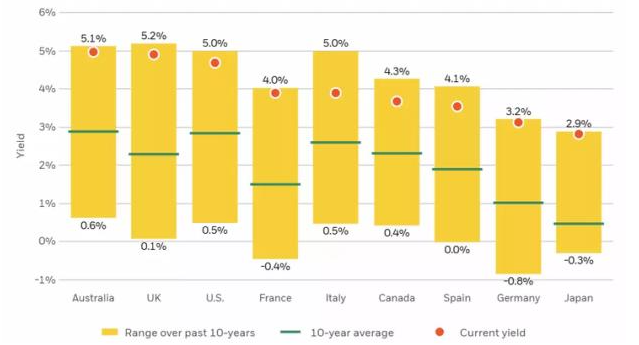
(Image Courtesy: BlackRock)
So what would it take for these yields, particularly the U.S. variety, to threaten the market rally? BlackRock has the answer.
“During the past 3 years, U.S. 10-year yields have averaged roughly 4.3%. Should yields climb above 4.8%, around the early August peak, that would put rates at the threshold that has typically been associated with negative stock returns,” according to the asset manager.
Treasury Yields Threaten Market Rally: Is It Avoidable?
Possibly, but elevated borrowing costs in the U.S. aren’t the most desirable situation. Treasury yields threatening the market rally would likely be realized in the form of those high bond yields sapping equity valuations, increasing discount rates and making the income offered by those bonds more attractive than equity ownership.
History is littered with examples of that scenario playing out, but it’s possible that this time will be different because earnings growth and equity market valuations are proving surprisingly compelling against the backdrop of bond market tumult.
“While yields are higher, surging earnings have left the stock market, and technology companies in particular, cheaper than they were at the start of the year. But while the market has thus far been able to ignore rising rates, we’re not far from the point where they have generally started to bite,” concludes BlackRock.
