


With the Russell 2000 Index beating the S&P 500 by a margin of better than 2-to-1 this year, it’s not surprising that small-cap stocks and the related ETFs are generating more attention.** **It’s probable, if not highly likely that advisors are fielding more questions from clients regarding small-cap exposure.
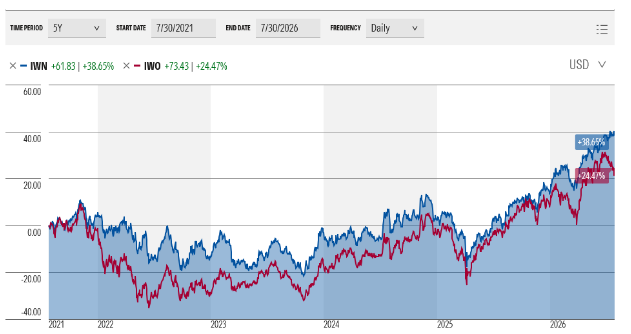
Amid that hoopla, a long-running debate rages on: Small-cap value vs. growth. As advisors know, small-cap value was for decades one of the most potent factor combinations. Then came a lengthy era in which large-cap growth outperformed, weighing on smaller equities of all stripes. But as the chart below indicates, small-cap value has the advantage of its growth rival over the past five years. The blue line is the iShares Russell 2000 Value ETF (IWN) and the red line is the iShares Russell 2000 Growth ETF (IWO).
(Image Courtesy: Morningstar)
That gap in favor of small-cap value vs. growth is interesting because it was largely accrued at a time when large- and mega-cap growth stocks led the market higher. To be sure, small-cap value was assisted by the post-pandemic economic recovery and the 2022-23 interest rate-tightening campaign by the Federal Reserve, which as the chart highlights, was a real drag on small-cap growth.
Small-Cap Value vs. Growth: Patience Matters
For market participants that need clarity regarding small-cap value vs. growth, much of it boils down time horizons. Over shorter periods, particularly when the Fed is accommodative, small-cap growth can and does work. However, for long-term investors, small-cap value is often the better risk-adjusted bet.
Part of the reason for small-cap value’s potential long-durability is that bargain pricing isn’t the only benefit associated with value stocks.
“Additionally, value funds don't emphasize growth above all, so even if the stock doesn't appreciate, investors typically benefit from dividend payments,” according to Fidelity. “Value stocks have more limited upside potential and, therefore, can be safer investments than growth stocks.”
Yes, the number of dividend-paying small-caps has increased in recent years, but the bulk of those names hail from the value realm. Just look at the the Russell 2000® Dividend Growth Index is worth a look. That gauge, which mandates that member firms increased payouts for at least 10 straight years, is the dividend offshoot of the widely followed Russell 2000 Index. The dividend benchmark has been a better long-term bet than its traditional counterpart.
Small-Cap Value vs. Growth: Settling the Score
Settling the small-cap value vs. growth “beef” includes an element of risk tolerance, meaning investors that can absorb more risk may be better served with growth. Fortunately, the economic climate is conducive to small-cap ownership at large.
“We believe small-cap companies stand to be the biggest beneficiaries of the US economy’s strengthening, given their relatively larger exposure to it. In fact, almost 70% of small-cap companies generate more than 90% of their sales domestically, compared to less than 40% for large companies,” according to Alliance Bernstein.
Something else to consider. Small-cap earnings growth estimates are soaring and that’s beneficial to value stocks in the space because many are profitable. Over 40% of the companies in the Russell 2000 aren’t profitable and many of them are growth names.
