


Advisors and informed investors know that midterm Election Day is about nine weeks away and while a lot can change between Labor Day and Election Day, advisors and investors can take heart in knowing that despite constant fluctuations in prediction markets, there are some certainties readily identifiable today.
First, voters (still) aren’t happy and that discontent boils down to a lot of the same reasons the electorate wasn’t feeling too chipper leading up to the 2024 presidential election. Second, the presidency isn’t changing hands. Third, it appears to be a foregone conclusion that Democrats will gain control of at least one of the two chambers of Congress, meaning some form of gridlock is coming.
Equity investors need not fret because history indicates that S&P 500 often performs better under divided governments than unified equivalents. As just one example, the gridlock from 1994 to 2000 is widely considered one of the reasons why stocks performed well under President Bill Clinton (D).
Yet even with that compelling history, investors dislike political gridlock because it limits the odds of sweeping policy alterations that could benefit markets. Barring surprises, market participants ought to get accustomed to the idea of dividend government come January 2027.
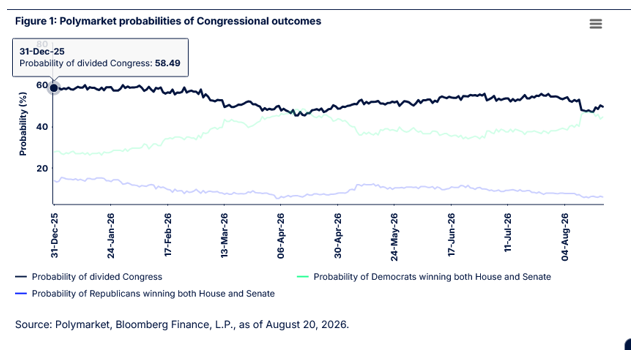
(Image Courtesy: State Street)
Perspective Matters
Advisors worth their salt won’t patronize clients by saying electoral outcomes don’t matter. They do. Politics shape markets, but it’s also worth remembering that primary driver of returns are fundamentals.
“The midterms add another unknown to a year already defined by uncertainty and geopolitical tensions. But positioning portfolios is less about predicting who wins and more about focusing on the fundamentals,” notes Michael Arone, chief investment strategist at State Street Investment Management.
If anything, the imminence of the midterm election and clients’ related jitters present advisors with an ideal opportunity to calm those nerves and keep clients focused on the long game.
“Regardless of the outcome, the takeaway for investors is clear: stay focused on long-term objectives, remain disciplined through periods of volatility, and avoid letting election headlines or outcomes drive portfolio decisions,” adds Arone.
Look Further Out
Part of advisors’ nerve-calming quests involves keeping investors invested when the political winds of change howl. It’s important work because as I noted in late July, the best year for stocks in the four-year presidential cycle is the third year, that being 2027.
Said another way, gridlock may be coming. It likely is. But that’s not a reason to sell in November and go away. If anything, that could be a punitive strategy.
“But the year after the election has historically delivered strong returns. The S&P 500 has not declined in the 12 months following a midterm election since 1930. The average post-midterm price return is 14%,” says Arone. “Political uncertainty produces volatility, but the post-election period has rewarded investors who stayed the course.”
