


Written by: Chris Carnazzo | Your Money Cues
ABLE accounts let people with disabilities save without jeopardizing their means-tested benefits. They are one of the most useful financial tools we have. And they are barely being used.
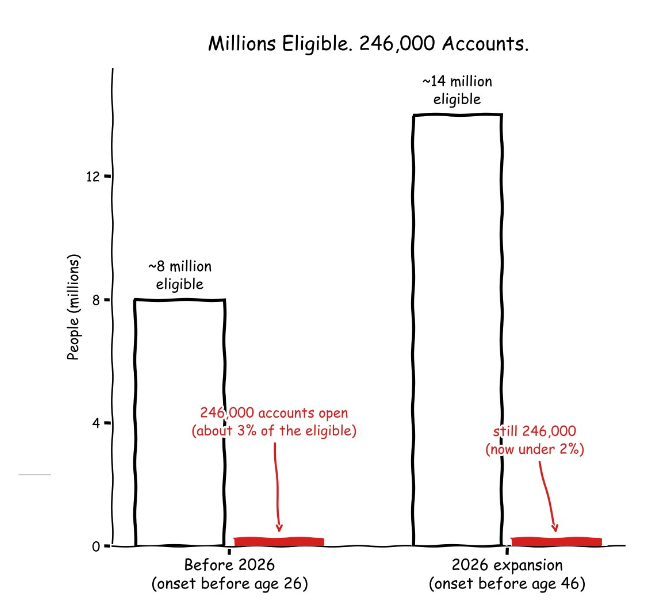
As of the first quarter of 2026, only about 246,000 ABLE accounts had been opened nationwide, according to the National Association of State Treasurers' ABLE Today program. Even before this year's expansion, that represented only about 3% of the roughly 8 million Americans who were eligible.
Beginning in 2026, Congress increased the disability onset age from 26 to 46, expanding eligibility to an estimated 14 million people. Measured against today's eligible population, the 246,000 existing accounts represent fewer than 2% of those who could benefit. Even after a decade, that is where adoption stands.
Disability policy researcher Robert Weathers and his colleagues analyzed Social Security administrative records to measure real-world ABLE account adoption. They found that among Supplemental Security Income recipients whose disability began before age 26, only 1.1% had an ABLE account as of December 2021.
The People Who Need Them Most
SSI recipients live under one of the strictest financial rules in the federal government. A person generally cannot have more than $2,000 in countable resources without risking benefits. Congress created ABLE accounts, in part, to solve that problem. Yet the people most constrained by the asset limit are the least likely to have the very account designed to help them.
What Two New Studies Found
Why? Two recent studies approach that question from different directions.
Stephen Roll and his coauthors examined barriers to ABLE account adoption. They found that awareness of ABLE accounts remains low. They also found that annual account fees reduced people's reported likelihood of saving in an account. Surprisingly, minimum opening balances had little effect.
Weathers and his colleagues, on the other hand, examined actual account ownership using Social Security administrative records. They also found substantial differences from state to state. That suggests program design, outreach, and administration influence whether eligible people enroll.
You Can't Save What You Don't Have
One obvious explanation is that many eligible people simply do not have money to save.
That is certainly part of the story. Surveys consistently find that many eligible people report having little or nothing available to contribute. An account cannot solve the absence of income.
What If Enrollment Were Automatic?
Guglielmo Briscese, Michael Levere, and Harold Pollack reviewed the evidence on ABLE account adoption and identified several priorities for future research. One recommendation stood out. They argue policymakers should explore ways to reduce the friction involved in opening an account, including automatic or opt-out enrollment where legally possible.
That idea sounded familiar. Retirement researchers have been studying defaults for years.
Before automatic enrollment became common, employees had to complete paperwork before joining a 401(k). Then Brigitte Madrian and Dennis Shea studied what happened after one employer switched to automatic enrollment.
Participation jumped. The retirement plan did not become more generous. The investment menu did not change. The employees did not change. The default changed.

Richard Thaler's work in behavioral economics helps explain why. People put off complicated decisions. They accept reasonable defaults. They often choose the option requiring the least effort.
An Idea, Not an Answer
Would the same thing happen with ABLE accounts? Briscese, Levere, and Pollack present the idea as one possible direction for future policy, not a proven solution. ABLE accounts operate under a different legal framework than employer retirement plans. Questions of consent, account ownership, and who has the authority to establish an account would all have to be resolved.
Even if those issues could be addressed, automatic enrollment would not solve every problem. People still need money to contribute. They still need to understand how the account works. They still need to coordinate it with public benefits and, in many cases, a special needs trust. An account with no money in it solves very little.
Even so, I think the paper raises an interesting question.

If opening an ABLE account requires someone to discover the program, determine they qualify, compare state plans, complete the paperwork, and decide how to invest the money, maybe we should not be surprised that participation remains so low. Most of us have abandoned applications halfway through for far less.
What Planners Can Do

That brings me to financial planners. When a planner identifies an eligible client who doesn't have an ABLE account, don't simply recommend one; offer to open it together.
How many of your clients who qualify for an ABLE account actually have one?
References
Briscese, G., Levere, M., & Pollack, H. (2024). Improving financial security for people with disabilities: The promise of ABLE accounts (Working Paper WI23-10). University of Wisconsin–Madison Retirement and Disability Research Center. https://rdrc.wisc.edu/files/working-papers/WI23-10_Working-Paper_Pollack-et-al_4.24.pdf
Madrian, B. C., & Shea, D. F. (2001). The power of suggestion: Inertia in 401(k) participation and savings behavior. The Quarterly Journal of Economics, 116(4), 1149–1187. https://doi.org/10.1162/003355301753265543
Roll, S., Ferris, D., Bufe, S., & Kondratjeva, O. (2025). Designing savings accounts to promote asset building for individuals with disabilities: Experimental evidence on ABLE accounts. Journal of Disability Policy Studies, 36(3), 165–175. https://doi.org/10.1177/10442073241304109
Thaler, R. H., & Sunstein, C. R. (2008). Nudge: Improving decisions about health, wealth, and happiness. Yale University Press.
Weathers, R., Kelly, P., & Hemmeter, J. (2024). ABLE account use among Supplemental Security Income recipients. Journal of Vocational Rehabilitation, 60(1), 99–119. https://doi.org/10.3233/JVR-230059
Notes
The 246,000 account count is from the National Association of State Treasurers' ABLE Today program data for the first quarter of 2026.
The figures of roughly 8 million eligible Americans before 2026 and an estimated 14 million after the eligibility expansion are National Disability Institute estimates, as reported by the ABLE National Resource Center (https://www.ablenrc.org/the-able-age-adjustment-act-fact-sheet/).
