
Going Beyond Awareness: What I actually do when understanding isn't enough
Most of what I write comes back to the same idea: fear runs through everyday life far more than we realize, and noticing it is often the first real opening to something deeper.
But I’ve learned, both as a doctor and as someone who has lived through more than my share of fear, that noticing isn’t always enough on its own. The same brain systems involved in fear can also generate real physical and emotional symptoms, and those symptoms can be stubborn enough to keep us stuck even after we understand exactly where they’re coming from.
So alongside the essays, I want to start sharing some of what actually helps me when awareness alone doesn’t quiet things down. Supplements I’ve tried. Changes to how I sleep, move, and eat. Small routines that make a difference on the harder days. None of it is meant as a prescription, and I’m not telling you what to do. It’s simply what I’ve found useful, offered in case some of it is useful to you too.
I’ll fold these in occasionally, not every week, alongside the Sunday essays and Wednesday reflections you already get.
It’s not news to anyone that nothing lasts forever, especially living organisms. As we age, our bodies undergo senescence, the gradual decline in a cell’s or organism’s ability to function, divide, and repair itself over time. This happens whether we like it or not. Leave well enough alone, and we decay.
I learned this early. When I moved, I felt better. Less lethargic. A clearer head. In medical school and residency, karate and running were my medications of choice for anxiety and the low moods that come with the territory. It wasn’t just my body that changed. My anxiety did too, steadier, less quick to spike, easier to talk myself down from.
As I’ve aged, that lesson has only become more important. My goal these days isn’t a longer lifespan. It’s a longer healthspan, meaning as many good years as I can get, not just more years.
An injury in my thirties left me with hip osteoarthritis. Through my forties and into my fifties, I stayed active: tennis, hot yoga, some running, but not consistently, and never with any real strength training. A friend kept encouraging me to join a cross-training group he belonged to, and I had an excuse ready every time. I was too busy. Eventually I ran out of excuses and gave it a try. I was hooked almost immediately.
I’d wanted to do that kind of training for years, the sort I’d see featured in fitness magazines, but never knew where to start or whether I even could. Once I began, I quickly realized my hip was going to hold me back. So I had it replaced. That changed everything. From there, I found my way into CrossFit, and I’ve stayed with it since.
I want to be clear about something here, because I know this kind of training can sound intimidating from the outside. You do not need to do CrossFit. You do not need to do anything that looks like what I do. What you need is to move, consistently, in a way that challenges your muscles a little more than yesterday. That can be a class, a set of dumbbells at home, a resistance band, a long walk with a weighted pack. The form matters less than the fact that you showed up.
Here’s part of why it matters so much as we age. Sarcopenia is the medical term for the muscle loss that comes with time, and it starts earlier than most people expect. Somewhere around thirty, we begin losing muscle mass every year unless we’re actively working against it. Left unaddressed, that adds up to something real: the difference between carrying your own groceries at eighty and needing help to do it.
Bone works the same way. It’s living tissue, constantly breaking down and rebuilding, and that rebuilding slows with age unless we give it a reason not to. Load-bearing movement, anything where you’re working against resistance or your own body weight, helps preserve and stimulate bone instead of just losing it. This matters most for women after menopause, but it matters for all of us eventually.
Joints have their own story. Articular cartilage doesn’t have its own direct blood supply, so movement helps circulate the synovial fluid through which it receives nutrients. I learned through my own hip that simply protecting an arthritic joint by avoiding movement isn’t necessarily protecting it at all. The right movement can help preserve mobility, strength, and function, while prolonged inactivity often worsens stiffness and weakness.
And then there’s circulation, which touches nearly everything else. Every organ depends on blood flow to deliver nutrients and oxygen, and the brain may depend on it more than any other. Dementia is one of the fears I hear about most, from family and friends who still come to me to talk medicine, and from readers. We don’t fully understand every reason exercise appears to benefit the aging brain, but the practical message holds up that movement is one of the more reliable things within our control when it comes to brain health, at a time in life when so much else can feel entirely out of your hands.
None of this is exotic information. It’s the kind of thing I knew for years as a physician before I started actually living it as a patient of my own advice.
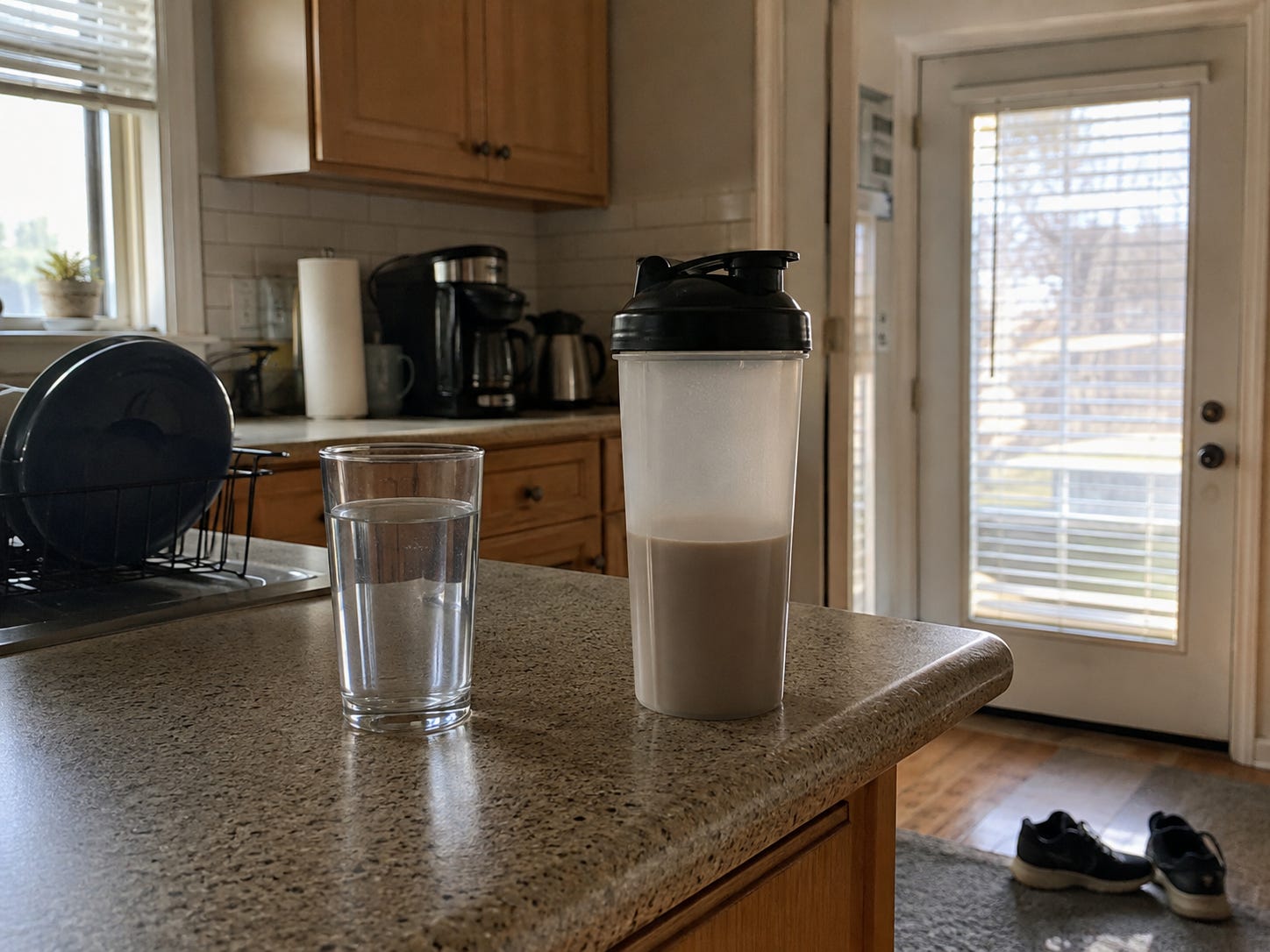
Here’s what that looks like for me now. I consume roughly three-quarters of a gram of protein per pound of body weight (some research recommends more, but I find that difficult to sustain and am not sold on the idea that more is better). Creatine is one supplement where the research has gotten my attention. Studies in older adults suggest that, particularly when combined with resistance training, it can improve gains in muscle mass and strength, with maintenance doses commonly studied around three to five grams daily. My own routine is a little different: I generally use about five grams on training days and less on rest days. I’m not suggesting my schedule is superior. It’s simply the routine I’ve settled into. I use an exercise powder called Kaged, without stimulant, that includes creatine among other workout-supporting ingredients. I add beet extract in two forms for circulation, and CocoaVia, a concentrated cocoa-flavanol extract, mixed into a chocolate protein shake called Slate that provides 42 grams of protein. Cocoa flavanols have some intriguing cardiovascular data behind them, including the large COSMOS trial.
None of this is a prescription, and not everything that works for me will be right for you, especially if you’re managing a condition of your own or taking other medications. This is simply what I’ve built over years of paying attention to what actually changes how I feel, move, and function.
If you take one thing from this, let it be the simplest version. You don’t need a hip replacement or a CrossFit box to start. You need to move today, a little more than you did yesterday, and to keep doing that tomorrow. The goal was never to live longer for its own sake. It was to still be able to get up off the floor without anyone’s help.
