


The conventional wisdom that soaring Treasury yields threaten market rallies has been challenged of late. Mercifully, 30-year Treasury yields have modestly retreated from the recent high that took yields on long-date U.S. government bonds yields to the most elevated levels in 19 years, but at 5.21% as of Aug. 28, that’s still too high.
High enough to imply that a threat to this market rally cannot be ruled out. On the other hand, it can’t be ignored that the S&P 500 gained 4.08% for the month ending Aug. 28. Not to be lost in that shuffle is the ongoing strength of small-caps. The widely observed Russell 2000 Index is higher by 2.20% over that period, extending its year-to-date gain to 22.30%, or an advantage of nearly 900 basis points over the large-cap S&P 500.
Small-caps’ sturdiness against the backdrop of higher Treasury yields is all the more impressive when considering a significant percentage – by some estimates, 35% to 40% -- of Russell 2000 members aren’t profitable companies.
“Smaller companies are often viewed as more dependent on external financing and more vulnerable to higher borrowing costs, leading many investors to believe small caps should struggle during periods of rising interest rates,” observes Nationwide.
The Relationship Isn’t All It’s Cracked Up to Be
One reason that Treasury yields aren’t (not yet anyway) threatening the small-cap market rally is because while many smaller companies are capital-dependent, rates don’t always chart the course for smaller course.
“Yet history offers little evidence that interest rates alone have consistently determined the relative performance of small- and large-cap stocks,” adds Nationwide.
The point is, as the chart below confirms, large- and small-cap leadership fluctuates across various interest rate climates and rates aren’t always the reason behind those changes in leadership. Translation: Treasury yields can threaten any rally, but there are no guarantees of that happening.
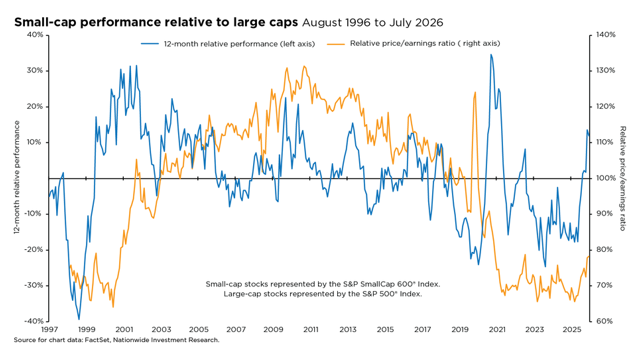
(Image Courtesy: Nationwide)
“Focusing exclusively on interest rates risks overlooking the factor that has historically mattered most for small-cap returns: earnings growth and economic resilience,” according to Nationwide. “Consensus estimates show earnings per share for the Russell 2000® Index growing at nearly twice the rate of the S&P 500® Index this year and next.”
More Positive Signs
Another important, though arguably overlooked reason why Treasury yields aren’t threatening the small-cap market rally is because the profitable members of the Russell 2000 are beating their money-losing counterparts on a year-to-date basis. That says quality, not junk, is supporting small-cap upside.
Add to that, Treasury yields may not threaten the market rally because breadth is widening, which is also supportive of small-cap bullishness.
“Yet as market leadership broadened, the narrative shifted dramatically. From 2000 through 2007, small caps outperformed the S&P 500 in each year, by an average of roughly 11% annually,” concludes Nationwide. “Extending the horizon further, small caps outperformed in 10 of the 11 years from 2000 to 2010, by an average of about 8% per year. This episode serves as a reminder that periods of extreme concentration and persistent relative underperformance often sow the seeds of future leadership.”
