


Thanks in part to the rise of buffer or defined outcome ETFs and some clients’ thirst for low volatility investing strategies, options-based income ETFs are among the fastest-growing segments of the already rapidly growing ETF landscape.
As of the end of 2025, options-based and defined outcome ETFs had $78 billion in assets under management (that total is higher today), representing 39% annualized organic growth over the past three years, according to Morningstar.
Buffer ETFs epitomize the old saying about there never being a free lunch in investing. To gain the downside protection offered by these products, investors sacrifice something and it’s significant. That being full participation in a bull market. That said, understanding why defined outcome ETFs are notching significant growth and why some issuers will acquire related growth is easy. For as much as advisors and clients like upside, they equally, if not more, love downside protection. Buffer ETFs provide that.
However, defined outcome ETFs aren’t the entire universe of options income funds. Plenty of high-yield covered call ETFs are on the minds of clients and captivating significant dollars from retail investors, but many of these market participants aren’t aware of the risks associated with covered call ETFs.
Clients Need to Know Covered Call ETF Risks
Excluding buffered products, seven options income ETFs have north of $2 billion in assets under management. Dozens more have at least $100 million in assets (often the barometer of ETF success) up to nearly $2 billion, confirming the yield draw is strong.
Often missed in the enthusiasm for those big yields are the risks of covered call ETFs. Chief among those drawbacks are the facts that these ETF often don’t provide the downside protection investors believe they do and upside participation, particularly during market rebounds is limited.
“The stock market crash early in the COVID-19 pandemic provides an example of the lack of downside protection from monthly covered call strategies,” according to ProShares. “The S&P 500 dropped roughly 32% from highs in February 2020 to a low point in March 2020. Investors in traditional covered call strategies expecting downside protection during that period would have been disappointed. The Cboe S&P 500 BuyWrite Index—a proxy for traditional monthly covered call strategies—declined by 29%, almost as much as the S&P 500.”
So rather than provide protection, covered call ETFs subjected investors to essentially comparable to an S&P 500 Index. Staying with the pandemic example, the risks of covered call ETFs were on display when the market snapped out of its 2020 and rallied mightily.
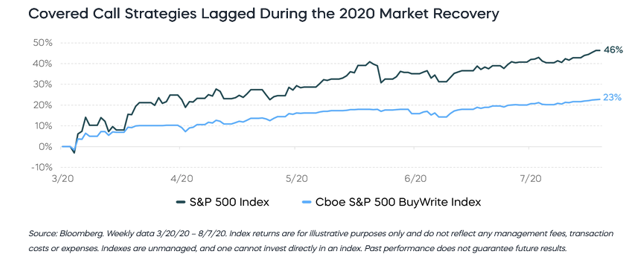
(Image Courtesy: ProShares)
Remember ROC
One of the other big risks with covered call ETFs – one many unknowing retail investors overlook upon being seduced by high levels of income – is the concept of return of capital (ROC). ROC is what it implies – the return of investors’ capital to them and it occurs when the fund cannot generate enough income through its underlying options strategy.
Indeed, that is risk of covered call ETFs because while the income level appears impressive, investors are essentially paying a management fee to have their money returned to the.
Exacerbating this risk of covered call ETFs is that it’s prominent with ETFs that seduce investors with either jaw-dropping yields, weekly payouts or both. Bottom line: If you’re an income-hungry investor considering covered call ETFs, first evaluate the risks and talk to an advisor prior to hitting the “buy” button.
Related: SpaceX's IPO Slump Isn't the Story—Its ETF Impact Is
